
People Also Search For (PASF): The Hidden Google Feature That Can Skyrocket Your SEO
Have you ever seen how Google gives you new suggestions after you click on a result and then go back to the search page? That little change isn’t random. Google is improving your intent in real time. This is exactly where people also search for become powerful.
People Also Search For (PASF) is a Google SERP feature that shows up when people don’t find what they’re looking for and go back. It shows queries that are very similar to each other based on how they act. These suggestions are more than just different versions of the same keyword; they show what users really wanted to find.
For example, someone searching “digital marketer” might return and see suggestions like “digital marketing agency” or “top 10 digital marketing agencies“. That shift tells you the original result didn’t fully match their intent, and Google is trying to bridge that gap.
For marketers, this is a direct insight into real search behaviour. PASF helps you understand how users change their searches and what content they expect next, rather than just using keyword tools. When you make your content fit with these patterns, you automatically make it more relevant, interesting, and higher in the search results.
If your content answers not just the initial query but also the follow-up intent reflected in PASF, you stand a much stronger chance of ranking higher and keeping users on your page.
What is “People Also Search For” in Google SERPs?
You type something into Google, click on a result, and in a few seconds, you’re back on the search page. There, Google quietly changes the results by adding a new set of suggestions. That’s People Also Search For, and it’s one of the most behavior-driven features on the SERP.
In simple terms, People Also Search For (PASF) shows other search terms that people often look for when they don’t find what they were looking for. It shows how real users act, not what you think they do. From a technical point of view, user interaction signals, like pogo-sticking, which is when a user clicks on a result and quickly goes back to the SERP, trigger PASF. Google sees this as a sign of dissatisfaction and responds by giving you more relevant search options.
Unlike many other SERP features, PASF isn’t always visible by default. Some queries always show features like featured snippets or People Also Ask, but PASF is more flexible. It depends on how people use search results in real time, which makes it much more personalised and based on what they want.
This is when it becomes useful for SEO. PASF doesn’t just show keywords that are related. It shows you what users wanted but didn’t get, which gives you a clear idea of how to make your content better or add to it.
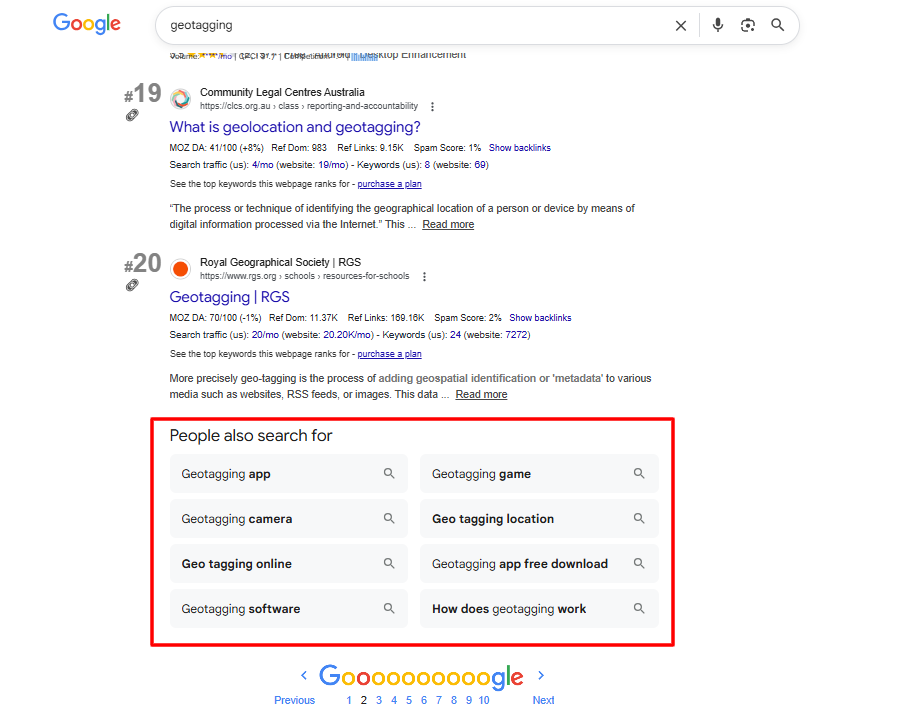
When and Where Does PASF (People Additionally Search For) Appear in Search Results?
PASF doesn’t just show up out of the blue. It shows up when certain actions by the user show that the first result didn’t meet their expectations. This happens a lot when someone clicks on a page and then quickly goes back to Google, usually within a few seconds. That return action tells Google that the content may not have been relevant enough.
When you click on a result on a desktop, PASF suggestions usually show up right below it. On mobile, the experience is smoother because suggestions blend in with the scroll, making them stand out even more for people who are quickly looking through options.
Behaviour is what causes PASF. You can turn on these suggestions by quickly bouncing, refining your query multiple times, or switching between results. In many cases, the questions that PASF shows are more specific or slightly different from what the user really wants, which helps them get closer to what they really want.
This is a strong sign for marketers. If users are leaving and triggering PASF, it usually means that your content doesn’t fully meet their needs. Optimising for these follow-up questions can greatly boost engagement and search performance.
People Also Search For (PASF) vs. People Also Ask (PAA)
PASF and People Also Ask might seem similar. Both appear inside Google search results, and both suggest related queries. But in reality, they serve very different purposes and are driven by completely different signals.
Most marketers miss out on an opportunity when they don’t understand this difference. Your SEO strategy stays surface-level if you treat them the same. You can answer both quick questions and deeper user intent at the same time if you use them correctly.
PASF and PAA: Main Differences (Intent, Trigger, and SEO Impact)
The main difference is when and how they show up. People Also Ask is a static SERP feature that shows a list of questions related to the original query. It’s designed to expand the topic and help users explore without leaving the page.
In contrast, PASF is behavior-driven. It appears only after the user selects a result and returns. This makes it much more responsive and closely related to user satisfaction.
Here’s a clear comparison to understand how they differ:
| Factor | PASF (People Also Search For) | People Also Ask (PAA) |
| Trigger | Appears after user returns to SERP | Appears automatically on SERP |
| Intent Type | Refined or secondary intent | Exploratory and informational intent |
| User Behavior | Based on dissatisfaction or query refinement | Not dependent on user interaction |
| SEO Value | Helps optimize for deeper intent and missed queries | Helps capture featured snippets and question-based traffic |
| Visibility | Dynamic and not always visible | Consistently visible for many queries |
From an SEO standpoint, People Also Ask helps you capture attention early by answering common questions, while PASF helps you recover missed intent and improve engagement after the first click.
Which One Matters More for Your SEO Strategy?
The real answer is not choosing one over the other. It’s about using both in a smart way.
If you want to get traffic and rank higher, you need to optimise for “People Also Ask.” It makes your content more likely to appear in featured snippets and gives it greater visibility right on the SERP.
But if your goal is to improve content depth, reduce bounce rates, and align with real user behaviour, PASF will be more helpful. It tells you what users wanted but couldn’t find, which is important for making content that works well.
A smart SEO plan uses both at the same time. Use People Also Ask to organise your content around common questions, and then use PASF insights to add more layers of intent. This mix not only helps your rankings, but it also makes your content more complete and useful.
While PASF helps you remain relevant and keep users interested, People Also Ask helps you be found.
Why People Also Search For is a Goldmine for SEO
Most marketers look at PASF as just another way to find keywords. That’s a mistake. What makes People Also Search For powerful are not the keywords themselves, but the intent behind them. It gives you access to how users actually think, refine, and continue their search journey when the first result doesn’t meet their expectations.
If you use PASF strategically, it becomes more than a keyword source. It turns into a blueprint for building deeper, more relevant, and high-performing content.
1. Reveals Real User Intent (Not Just Keywords)
Traditional keyword research tells you what people search. PASF explains what they really meant.
When people go back to Google and change their search, they are giving direct feedback. For example, a search for “content marketing” might lead to PASF suggestions like “content marketing services” or “content marketing for small business.” That shift reveals a clearer intent that wasn’t fully captured in the original query.
This helps you move beyond generic targeting and create content that directly answers what users are actually looking for.
2. Helps Build Topical Authority Clusters
PASF naturally finds other questions that are related to the same topic. You can build a more organised content strategy by putting your keywords into groups instead of treating each one separately.
For example, one main topic can grow into several supporting sections or blogs depending on how PASF is set up. This method boosts your topical authority, which is an important ranking factor in modern SEO.
When search engines see consistent, in-depth coverage of a topic, they are more likely to trust and rank your content higher.
3. Improves Content Depth & Engagement Signals
One of the main reasons people leave is that the content isn’t deep enough. PASF shows exactly what’s not there.
Incorporating PASF queries into your content naturally increases its comprehensiveness. This reduces the need for users to return and search again, increasing engagement signals such as time on page and decreasing bounce rate.
Better engagement tells Google that your content meets user intent, which can boost rankings.
4. Supports AI Search & Semantic SEO
It’s not enough to just match keywords anymore. Google uses advanced natural language processing (NLP) models and entity-based understanding to figure out what things mean, how they relate to each other, and what the context is. PASF fits perfectly into this ecosystem because it reflects how queries are semantically connected.
You’re not just adding keywords when you use PASF insights to improve your content. You’re putting things in context around people, things, and what users want. This makes it more likely that your content will show up in AI-generated answers and new SERP features.
In short, PASF helps you write content that works with how modern search engines think, not just how they find keywords.
Don’t just use PASF as a keyword tool; use it as a way to plan and create content that really ranks and gets people interested.
How Does PASF Work?
PASF might look like a simple box for suggestions. In reality, it is driven by a combination of user behaviour, query relationships, and machine learning models operating in the background. Google is always watching how people use search results and changing what it shows next based on those patterns.
Knowing how this works gives you an edge. Rather than guessing what users want, you begin to align your content with how Google interprets their behaviour.
User Behavior Signals (Clicks, Bounce, Reformulation)
How users interact with search results is where everything begins. When someone clicks on a page and quickly returns to Google, it sends a strong signal that the content didn’t fully meet their expectations. This behaviour, often called pogo-sticking, is one of the primary triggers for PASF.
Google doesn’t just pay attention to one click. It observes patterns. Google starts to figure out that the original results are missing something when a lot of people search for the same thing, click on similar results, and then come back to refine their search.
That’s when PASF suggestions show up, giving users other questions that are more likely to be what they want to know next.
Relationships between queries and semantic mapping
When Google sees a gap in intent, it doesn’t just come up with random suggestions. It depends on how queries are related to each other semantically.
For example, if someone searches for “social media marketing“, related queries like “social media advertising“, “social media marketing agency” or “social media optimisation” are not just keyword variations. They are part of a connected topic cluster.
Google maps these connections by using data about context, meaning, and how people use the service. This lets it suggest searches that seem like a natural next step in the search process instead of random ideas.
This is a clear sign for SEO to look beyond individual keywords and focus on covering a topic.
Machine Learning & Search Prediction
At the core of PASF is machine learning. Google uses billions of searches, clicks, and refinements to learn what people are likely to search for next.
It finds patterns over time. If users who search for a certain term keep asking the same follow-up questions, those questions become part of PASF suggestions.
This ability to predict is what makes PASF so useful. It doesn’t just show what someone has done in the past; it also predicts what they will do in the future.
This means one thing for marketers. You aren’t just reacting to search trends; you’re staying ahead of them if your content fits with these predicted queries.
PASF works by using smart predictions and real user behaviour. Once you know how this works, you can make content that not only matches what people are looking for, but also what they are likely to look for next.
How to Find “People Also Search For” Keywords
Finding People Also Search For keywords, it’s not just about using one tool and exporting a list. It’s a mix of watching, figuring things out, and understanding how users move from one question to the next. The more closely you follow how people really search, the better your results will be.
Here are the best ways to find PASF keywords that are important for SEO.
1. Using Google SERPs Manually (Best Free Method)
The simplest method is still one of the most powerful. Start by searching your primary keyword on Google, click on one of the top results, and then return to the search page. In many cases, you’ll see PASF suggestions appear right below the result you clicked.
This method works because you’re replicating real user behavior. You’re not relying on estimates or tool data, but observing how Google responds to actual interactions.
To make this more effective:
- Try different variations of your main keyword
- Click on multiple results, not just one
- Repeat the process on both desktop and mobile
Over time, you’ll start noticing patterns in the suggestions. These patterns often reveal deeper intent layers that you can directly use in your content.
2. Using SEO Tools (Ahrefs, SEMrush, Keywords Everywhere)
While PASF itself isn’t always directly visible in tools, you can still extract similar insights using advanced keyword research platforms.
Tools like Ahrefs and SEMrush help you find related queries, keyword variations, and question-based searches that often overlap with PASF suggestions. Keywords Everywhere can also show related search terms directly within the SERP, making it easier to capture ideas quickly.
The key here is not to treat tool data as final. Instead, use it as a starting point and validate those keywords by checking how they appear in real search results. This combination of tool data and manual verification gives you more accurate and intent-driven keywords.
3. Extracting PASF via Search Intent Mapping
This is where most competitors fall short. Instead of just collecting keywords, you organize them based on intent.
Start with a primary keyword and list down all related queries you find through SERPs and tools. Then group them into categories such as informational, commercial, or problem-solving intent. You’ll begin to see how users move from broad searches to more specific ones.
For example, a broad query might lead to follow-ups that focus on strategies, tools, or comparisons. Each of these represents a different stage of the user journey.
By mapping these connections, you can structure your content in a way that answers not just one query, but the entire path a user is likely to take.
The takeaway is straightforward. Don’t just collect PASF keywords. Observe them, validate them, and organize them around intent. That’s what turns raw data into a real SEO advantage.
How to Use PASF Keywords to Rank Higher
Finding PASF keywords is only half the job. The real advantage comes from how you use them inside your content. Most websites fail here because they treat these queries as isolated keywords instead of connecting them into a structured strategy.
If you approach PASF correctly, you can turn a single topic into a complete search journey that keeps users engaged and improves rankings across multiple queries.
Step 1: Build Content Around Search Intent Clusters
Start by grouping PASF keywords based on intent, not just similarity. When users refine their searches, they usually move from a broad idea to something more specific. Your content should reflect that progression.
For example, if your main topic is “SEO strategy,” related PASF queries might include “SEO strategy for beginners,” “advanced SEO techniques,” and “SEO strategy examples.” Instead of creating separate thin pages, you can build one strong piece of content that covers these layers in a structured way.
This approach helps Google understand that your content covers the topic comprehensively, which improves your chances of ranking for multiple variations.
Step 2: Expand Content with PASF-Based Subtopics
Once you have your intent clusters, the next step is to expand your content using them as subtopics. Each PASF query becomes a natural section within your blog.
Instead of stuffing keywords, you’re answering real follow-up questions users have. This makes your content feel more complete and reduces the need for users to go back to search again.
A simple way to structure this is:
- Start with a core topic
- Add sections that address deeper or refined queries
- Use natural transitions between sections to guide the reader
This creates a flow that mirrors how users think and search.
Step 3: Optimize for Featured Snippets and People Also Ask
PASF and People Also Ask work well together when used strategically. While PASF helps you understand deeper intent, PAA helps you capture visibility directly on the SERP.
To optimize for this, include clear, concise answers within your content. Use question-based subheadings and provide direct responses in the first few lines. This increases your chances of appearing in featured snippets or PAA boxes.
The key is balance. Don’t just answer questions. Expand on them so your content remains valuable beyond short answers.
Step 4: Internal Linking Strategy (Critical for Agencies)
PASF often reveals related topics that deserve their own dedicated pages. This is where internal linking becomes powerful.
Instead of forcing everything into one page, you can create supporting blogs or landing pages and link them strategically. This helps distribute authority and improves crawlability.
For example, a main blog on “SEO strategy” can link to:
- A detailed guide on keyword research
- A blog on on-page SEO techniques
- A page focused on SEO tools or services
This creates a connected content ecosystem rather than isolated pages.
Real Content Structuring Example
Let’s say you’re targeting “digital marketing strategy.” A strong structure would look like this:
- Main blog covering the overall strategy
- Sections addressing PASF queries like “digital marketing strategy for small business” and “digital marketing plan examples”
- Internal links pointing to deeper guides such as social media marketing or PPC strategies
This way, one page captures broad intent while supporting pages handle specific needs.
Use Case: Blog vs Landing Pages
For blogs, PASF works best to expand depth. You can cover multiple related queries in one piece, making it more informative and engaging.
For landing pages, the focus should stay tighter. Use PASF insights to refine messaging, address objections, and include supporting sections, but avoid overloading the page. The goal here is conversion, not just coverage.
The takeaway is clear. PASF keywords are most powerful when used as a framework, not just a list. When you structure content around intent, expand it thoughtfully, and connect it through internal links, you create a system that ranks, engages, and converts.
Advanced Strategy: How PASF Helps You Dominate AI Search Results (AI Pack)
Search is no longer just about ranking on page one. With AI-driven results like Google’s AI Overviews, the game has shifted from keyword targeting to intent coverage and contextual relevance. This is where PASF becomes a serious competitive advantage.
When you use People Also Search For strategically, you’re not just optimizing for traditional rankings. You’re aligning your content with how AI systems understand topics, relationships, and user intent at a deeper level.
PASF + Entity SEO + Topical Authority
Google doesn’t just read keywords anymore. It understands entities, which are concepts, topics, and their relationships. PASF naturally reveals these connections by showing how different queries relate to the same core topic.
For example, a primary query can branch into multiple related ideas like strategies, tools, comparisons, or use cases. When you cover these variations within your content or across your site, you’re building topical authority.
Instead of creating isolated pages, you create a network of content that reinforces your expertise. This helps search engines trust your website as a reliable source, which is critical for both traditional rankings and AI-generated responses.
Optimizing for Google SGE / AI Overviews
AI Overviews pull information from sources that provide clear, relevant, and well-structured answers. PASF helps you identify exactly what those answers should include.
If users consistently refine their queries in a certain direction, it signals a gap in existing content. By addressing those gaps, you increase your chances of being included in AI summaries.
To improve your chances:
- Cover the primary query and its follow-up intent within the same content
- Use clear headings that match real search queries
- Provide concise answers before expanding into detailed explanations
This makes your content easier for AI systems to extract and present.
Creating “Answer-First” Content Blocks
One of the most effective ways to leverage PASF is by structuring your content in an answer-first format. Instead of building up slowly, you provide a direct answer early and then expand on it.
This approach works well for both users and search engines. Users get immediate clarity, while AI systems can easily identify and extract key information.
A simple structure to follow:
- Start with a direct answer to the query
- Add a brief explanation or context
- Expand with examples, insights, or use cases
When you combine this format with PASF insights, your content becomes highly aligned with how modern search works.
The takeaway is straightforward. PASF is no longer just an SEO tactic. It’s a strategic tool for aligning your content with AI-driven search. If you focus on intent, entities, and structured answers, you position your content not just to rank, but to be featured in the next generation of search results.
Common Mistakes to Avoid When Using PASF Keywords
Using PASF keywords can significantly improve your SEO, but only if applied correctly. Many marketers collect these queries and try to force them into content without a clear strategy. That’s where things start to break. Instead of improving rankings, it often leads to cluttered content that doesn’t truly help the user.
Avoiding a few common mistakes can make the difference between average content and a high-performing page.
Keyword Stuffing Instead of Context Building
One of the biggest mistakes is treating PASF like a keyword list that needs to be inserted everywhere. This usually results in unnatural sentences and poor readability.
PASF keywords are not meant to be forced into content. They are meant to guide what your content should cover. Instead of repeating phrases, focus on answering the intent behind those queries in a natural way.
When your content flows logically and addresses real questions, keywords fit in automatically without sounding forced.
Ignoring Search Intent Layers
Not all PASF queries represent the same level of intent. Some are basic, while others are more specific or action-driven. Ignoring this difference leads to shallow content that only covers one layer of the topic.
For example, a broad query might require an introduction, while a refined query may need examples, strategies, or comparisons. If your content doesn’t address these layers, users are more likely to leave and continue searching.
The goal is to guide the reader from general understanding to deeper insights within the same content.
Creating Duplicate Content Instead of Clusters
Another common mistake is creating separate pages for every PASF keyword without a clear structure. This often leads to overlapping content that competes with itself.
Instead of publishing multiple similar pages, it’s more effective to group related queries into clusters. One strong page can cover multiple closely related intents, while supporting pages can handle more specific topics.
This approach improves clarity for both users and search engines, and helps build stronger topical authority over time.
The key takeaway is simple. PASF keywords should shape your content, not overload it. Focus on context, intent, and structure, and you’ll get far better results than trying to optimize for keywords alone.
PASF for Mobile SEO: Why It Matters More Than Ever
Think about how most people search today. It’s quick, instinctive, and almost always on a mobile device. Users scan results, tap a link, and if it doesn’t feel right within seconds, they go back and try something else. This behavior makes People Also Search For even more important in a mobile-first world.
With mobile-first indexing, Google primarily evaluates the mobile version of your content for ranking. That means how users interact with your page on mobile directly influences your SEO performance. If users bounce quickly and return to search results, PASF suggestions are more likely to appear, guiding them toward better-matched queries.
Mobile users behave differently compared to desktop users. They are more impatient, more intent-driven, and more likely to refine their searches multiple times. A query might start broad, but within seconds, it becomes more specific. PASF captures this transition in real time, showing exactly how user intent evolves on mobile devices.
This creates both a challenge and an opportunity. If your content isn’t clear, fast-loading, and immediately relevant, users will leave and trigger alternative suggestions. But if your page quickly addresses their intent and anticipates follow-up questions, you can keep them engaged and reduce the need for further searches.
To align with mobile behavior, your content should feel easy to consume. Clear headings, concise answers, and a logical flow make a big difference. When users find what they need without friction, it signals quality to Google and reduces the chances of PASF being triggered against your page.
In a mobile-first environment, PASF reflects how quickly users judge your content. The better you match their intent from the start, the stronger your SEO performance will be.
Internal Linking Strategy Using PASF (For SEO Agencies)
PASF gives you a clear idea of what users want to explore next, which makes internal linking more strategic instead of random. Instead of adding links just for SEO, you guide users to the next logical step in their journey.
For example, after discussing PASF keyword discovery, you can naturally link to deeper resources like SEO content strategy or a keyword research guide. When explaining execution or optimization, linking to an on-page SEO checklist or topical authority in SEO helps users move forward without searching again.
The best placements are right after the PASF keyword section and within the ranking strategy part of your content, where users are actively looking for actionable insights.
Use PASF to map user intent, then connect your pages in a way that keeps users engaged and improves your overall SEO structure.
Also Read About: Search Google or Type a URL: Which One Is Better For You?
Conclusion: Turn Google’s Suggestions Into Your SEO Growth Engine
People Also Search For is more than just a SERP feature. It’s a direct reflection of how users think, refine, and continue their search journey. When you start paying attention to PASF, you stop guessing keywords and begin understanding real intent, which is what truly drives rankings and engagement.
The opportunity here is clear. By aligning your content with PASF insights, structuring it around intent, and connecting it through smart internal linking, you create a system that not only ranks better but also keeps users on your site longer.
If you want to turn these insights into real results, it requires a strategic approach. That’s where Metaloop comes in as a digital marketing agency focused on building intent-driven SEO strategies. From identifying PASF opportunities to optimizing your content for better visibility and engagement, the goal is simple—help your website perform the way modern search demands.
The next step is yours. Start optimizing your content with PASF in mind, and you’ll begin to see how small search signals can lead to significant SEO growth.
Frequently Asked Questions About PASF
What is People Also Search For in Google?
People Also Search For is a Google SERP feature that shows related queries when a user clicks a result and returns to the search page. It reflects how users refine their searches when the initial result doesn’t fully match their intent.
How is PASF different from People Also Ask?
PASF appears based on user behavior, while People Also Ask is shown automatically as a list of related questions. PASF focuses on refined search intent, whereas People Also Ask helps users explore broader or related queries.
How do I rank in PASF results?
You don’t directly rank in PASF, but you can benefit from it by creating content that covers related queries and deeper intent. When your content matches what users look for next, it improves engagement and ranking potential.
Are PASF keywords important for SEO?
Yes, PASF keywords are valuable because they reveal real user intent beyond primary searches. They help you create more relevant, in-depth content that aligns with how people actually search.
Can PASF improve website traffic?
Yes, using PASF insights can increase traffic by helping you target additional related queries. It also improves user engagement, which can lead to better rankings and more consistent organic growth.

Write a Comment